
An exoskeleton that cuts ankle torque 19%, an AI co-pilot for shipbuilders, and 5 new concentrations for robotics majors
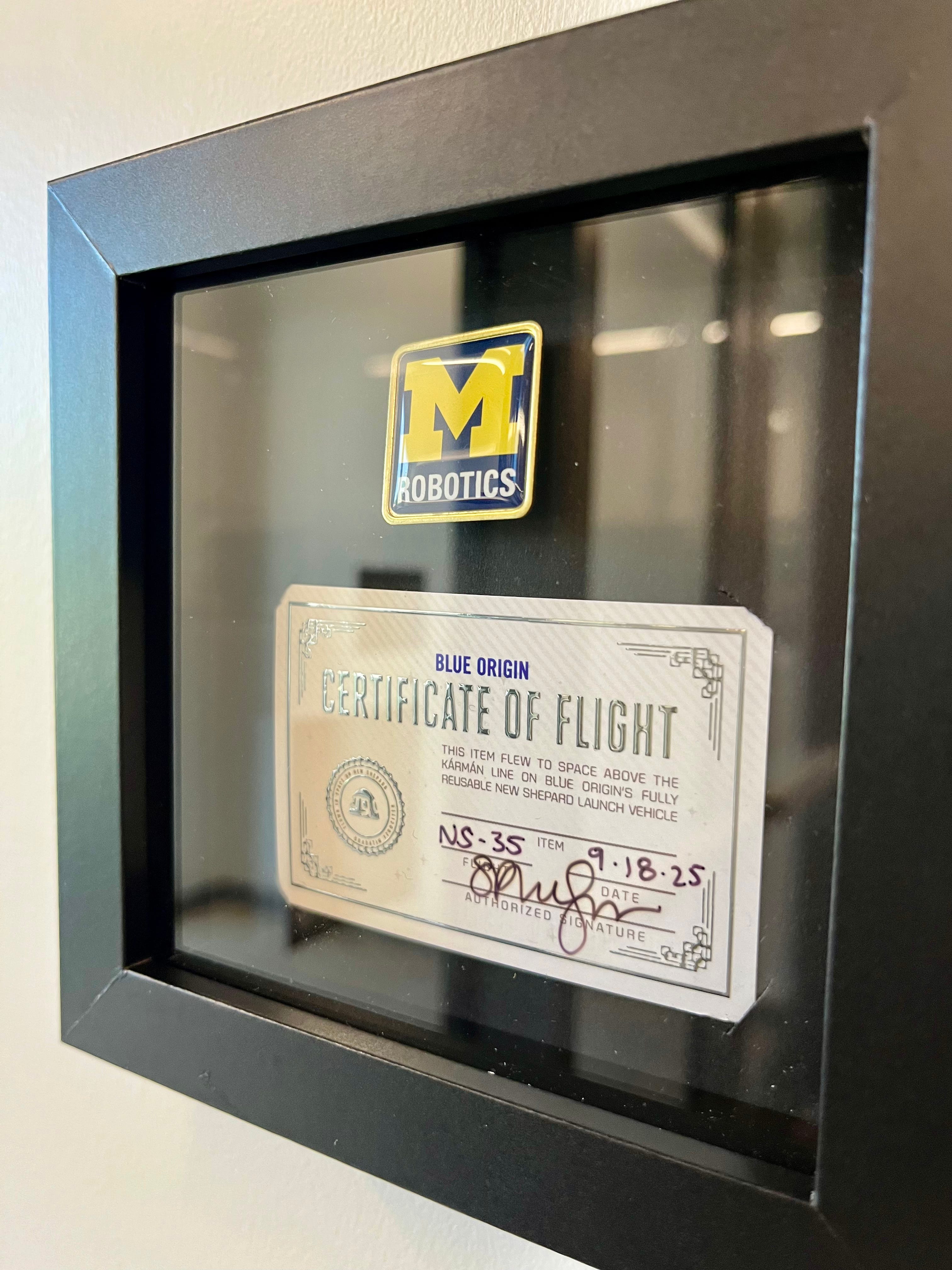
plus a robotics lapel pin's quick trip to space

Welcome to the Michigan Robotics newsletter, a summary of what’s happening in the University of Michigan Robotics community.
We’re excited to announce 5 new concentrations for the undergraduate robotics major. Starting this fall, Michigan Robotics undergrads can build depth in Perception and Reasoning, Robot Dynamics and Controls, Robotic Systems and Hardware, Human-Robot Interaction, or Full-Stack Robotics.
Now, the news.
Research
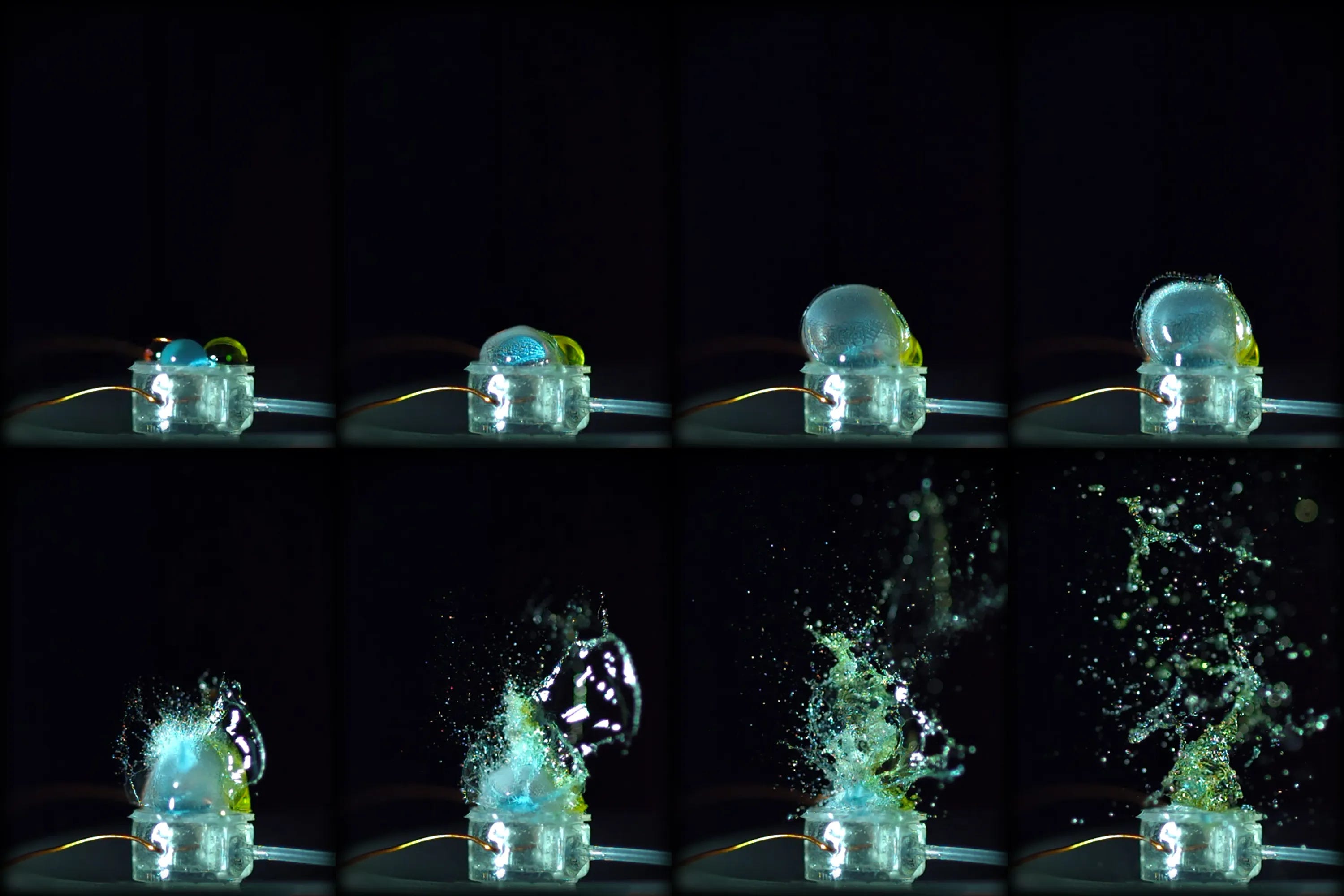
‘Spark of Color’ wins soft robotics art awards
A high-speed camera captured the explosive beauty of a combustion actuator from Cameron Aubin's lab. The piece won the Audience Choice and Image of Distinction awards at the 2026 IEEE RoboSoft conference in Kanazawa, Japan, and will appear on the cover of Soft Robotics. Credit to Manvi Saxena, Yihao Geng, Jason Brown, Dan Newman, and Cameron Aubin.
Robots and AI to help shipbuilding stay on track
As ships are built, internal parts often drift from the planned design, and reconciling the built ship with the digital model is slow, manual work. Alan Papalia leads a U.S. team developing robots and AI to act as a co-pilot for shipbuilders when reality and the design diverge, supported by a $6.2M grant from the Japanese Ministry of Land, Infrastructure, Transport and Tourism. The team also includes Leia Stirling, Patrícia Alves-Oliveira, Matt Collette, Thomas McKenney, and Faez Ahmed (MIT).
Mistake Attribution in egocentric video
Jason Corso, Yayuan Li, Aadit Jain, and Filippos Bellos present a model that doesn't just flag mistakes in first-person video but pinpoints which instruction was violated, when the mistake became unrecoverable, and where in the frame it happened.
ReloPush-BOSS: planning push manipulation in densely cluttered workspaces
Jeeho Ahn and Christoforos Mavrogiannis published a planner that lets a car-like robot push objects out of its way through cluttered spaces—up to 13 objects at a time. To be presented at IROS 2026.
Ankle exoskeletons that cut joint torque without machine-learning black boxes
Katharine Walters, Gray Thomas, and Robert Gregg developed a control framework for ankle exoskeletons that mimics natural biological torque without learned models. In a study with participants wearing bilateral ankle exoskeletons, the controller reduced biological ankle torque by nearly 19% which could improve comfort and relieve chronic ankle pain.
Open-Source Leg controllers, trained entirely in simulation
Ellie Wilson demonstrated end-to-end controller development for the Open-Source Leg purely in simulation, with preliminary results to be presented at the Dynamic Walking conference.
How human motion prediction shapes social robot navigation
Andrew Stratton, Phani Teja Singamaneni, Pranav Goyal, Rachid Alami, and Christoforos Mavrogiannis ran a large study finding higher prediction accuracy doesn’t reliably translate to better navigation performance, humans don’t reciprocate robot cooperation in tight spaces, and faster robot navigation often comes at the expense of human comfort.
Four new projects at the NSF Center for Digital Twins in Manufacturing
The center kicked off work on human digital twins for worker assistance (Wenlong Zhang, Dawn Tilbury), foundation models for design for manufacturing (Kira Barton, Wenlong Zhang), anomaly detection in metal 3D printing (Zhengtao Gan, Kira Barton), and syncing physical and simulated robots—the “diagnostic twin” (Dawn Tilbury, Giulia Pedrielli).
Legible robot motion in pedestrian environments
A paper from Pranav Goyal, Andrew Stratton, and Christoforos Mavrogiannis shows that signaling interaction-level intent works better than signaling the destination, and that benefit holds even when humans are distracted.
Promoting cooperation with security robots through fairness
Xin Ye and Lionel Robert presented work on how perceived fairness and value alignment shape whether people cooperate with security robotic authority.
Anthropomorphizing technology: a research agenda
Samia Cornelius Bhatti, Dorothy Leidner, Lionel Robert, and Hind Benbya published a framework for understanding how human-like cues in technology shape user responses to move past binary “acceptance vs. rejection” framings.
Robot-assisted social dining as White Glove Service
Atharva Kashyap and Patrícia Alves-Oliveira’s CHI 2026 paper looks at assistive feeding: the problem isn’t eating, it’s everything around eating. Through participatory design with people with disabilities, they argue these systems should function less like devices and more like attentive servers.
Speak2Scene: voice-based storyboarding for participatory design
Atharva Kashyap and Patrícia Alves-Oliveira built an open-source web tool that uses generative AI to create storyboards from speech, enabling people with upper-limb disabilities to participate in design sessions on equal footing.
Watch
Third-year undergrad Yulei Fu sits down with Professor Jessy Grizzle to talk about what the Robotics undergraduate major is actually like: “This major is for builders. For people that like to tinker. For people that recreationally like building things just for fun.” The conversation covers the new concentrations, why the best robotics job postings don’t always say “robotics,” and the difference between rigor that builds understanding and rigor that filters students out.
The Robotics Capstone showcase featured magnet swarms, autonomous soccer agents, automated well plates for microscopes, an odor source localization bot, a Jerboa-tail torque measurement tool, a continuous dilation monitor for labor, and three teams working with Subaru of America.
The annual ROB 550 competition closed out the semester for the staple grad-student introduction to sensing, reasoning, and acting, with MBots, mazes, and RViz.
In this PhD defense, Brandon Apodaca presents work on planning fuel-efficient, human-aware inspection trajectories for free-flying robots around orbital structures like the International Space Station.
In this PhD defense, Mark Van der Merwe presents work on how robots can develop a sense of contact for dexterous manipulation.
A documentary by Speedonthewater.com and Scrapyard Media follows U-M Electric Boat as the team chases the world speed record for an electric boat.
On May 1, the robot parade rolled through for graduation. Congratulations to all our graduates.
And throughout the term, the Robotics Pathways and Careers Speaker Series welcomed Jasmine Jaggers of the Zell Lurie Institute for Entrepreneurship, who broke down how student entrepreneurs at U-M turn campus pitches into $1M in funding; Kellen Schroeter, CEO of Pattern, on building machine learning systems; Mark Williams of Walter P Moore, on autonomous reality capture in the built environment; and our own Cale Colony on what brought him to study robotics and help lead startup motmot.
Read & listen
Using AI to extend healthcare into rural areas
Jason Corso on WJR 760 AM discusses how the VIGIL project, part of the ARPA-H PARADIGM program, uses AI to extend specialist-level healthcare into rural areas.
Making an impact and starting the Open-Source Leg community
Elliott Rouse joined the Humotech podcast to discuss the Open-Source Leg, lessons from auto racing and Google X, and why community matters in wearable robotics. Rouse also speaks at the AI for Good Global Summit in Geneva, July 7–10, on exoskeletons, prosthetics, and human-centered design.
Robotics, advanced manufacturing, and national security
Chinedum Okwudire and Dawn Tilbury are providing expertise to a new Special Competitive Studies Project commission examining how advanced manufacturing and robotics intersect with U.S. national security.
Why folding laundry is harder than running a marathon
“People have a cognitive bias to think that running a half marathon faster than a human is more difficult than folding laundry—which is not true,” said Yanran Ding in Scientific American, on what the latest humanoid-robot marathon does and doesn’t prove.
Congrats
Robotics Outreach Ambassadors of 2026
Anandi Arora
Onur Bagoren
Jessica Carlson
Jiawei Chen
Cale Colony
Zariq George
Seth Isaacson
Ted Ivanac
Yazid Marzuk Kalluparamban
Tianxiang Lin
Nandan Natesan
Abigail Rafter
Anja Sheppard
Anuhea Tao
Katharine Walters
Congrats to all the above for exemplifying the robotics value of enthusiasm for outreach. They were recognized for service across MEZ workshops, Wines Elementary Science Builder Fair, STEMulation 2026, and FIRST and FAMNM volunteering.
Congratulations to ROBOSYM award winners
Including Jiawei Liu, Jake Kanetis, Aparajito Saha, and Olivia Ma, and to organizers including Brandon Apodaca, Kavin Govindarajan, and Cody Sheltraw. ROBOSYM is the department symposium put on by the Robotics Graduate Student Council, where students share research and discuss work across the department.
First Robotics Hackathon Winners
Robotics graduate students Ted Ivanac and Shambhavi Singh organized the first hackathon to make use of retired robotics hardware from the department, with first place winners Tori Landrum and Amy Lang, second place winners Aidan Dempster, Julianne Barteck, and Cody Sheltraw, and third place winners Anandi Arora, Brandon McDonald, and Wenjun Cheng.
Justin J. Zheng received the Distinguished Academic Achievement Undergraduate Award
"Michigan Robotics has been truly amazing for me," said Zheng. "It has given me incredible opportunities to grow as a researcher and has helped me build meaningful connections with professors, researchers, and fellow students.
Yatee Balan received the Arlen R. Hellwarth Award
Beyond coursework, Balan is an instructional assistant for ROB 204 and Treasurer of U-M Society of Women Engineers, where she helped run a career fair drawing 200+ employers and 4,500 students.
Sangli Teng earned an Honorable Mention for the 2026 Rackham ProQuest Distinguished Dissertation Award
Teng received this for his work on optimization-based robot control and state estimation on matrix Lie groups.
Katharine Walters received a Rackham Predoctoral Fellowship
Walters received the fellowship for her research on adaptive lower-limb exoskeletons.
Chad Jenkins joined the Black in AI Board of Directors
Jenkins, the recently named ACM Fellow, will help guide the organization’s next chapter at the intersection of AI, robotics, and human-centered technology.
Marshall Vielmetti named NSF Graduate Research Fellow
Vielmetti joins the Robotics PhD program this fall, was named a National Science Foundation Graduate Research Fellow for his work on safety-critical control and multi-agent systems with Dimitra Panagou.
“One Click to Safety” semi-finalist in Life-Changing Education Idea Showcase
Anandi Arora, with Carolina Janicke and Ross McQuate, was selected as a semi-finalist (out of 700+ submissions) in the U-M Life-Changing Education 2026 Campus of the Future Student Idea Showcase for “One Click to Safety,” a unified campus safety platform.
Parting shot
I'm trying to save Civilization by drawing attention to an extraordinary moment that's trying to happen. The monks Theory of Everything is explaining mystery after mystery after mystery while our scientists are saying crazy things and admitting that they can't make sense of any of the crazy things they are saying and now cannot understand 95% of the universe.
We need to quickly start solving our problems which this allows us to do otherwise we will resort to violence to solve our problems. I was hoping that you would help me avoid that by letting me somehow talk to your audience or maybe write an article with you to your audience about this exciting moment and get some attention that it deserves?